Retrieval Systems and Flows
The need to search large text collections has its roots in library science. As described in the opening chapter, librarians and researchers relied on card catalogs, subject indexes, and classification systems for centuries. When collections outgrew manual methods, the first computerized retrieval systems automated what librarians had always done: match a user’s query against a catalog of documents. Today, the same principles apply far beyond libraries, from legal databases and patent archives to corporate knowledge bases and web search engines.
Across these applications, a retrieval system must answer three connected questions: what unit should be returned, what work can be completed before a query arrives, and whether matching documents should be filtered or ranked. These decisions determine the system architecture and the flow from source documents to results.
From Filtering to Ranking
Consider a university library with millions of articles and books. A researcher enters terms like “neural plasticity AND memory consolidation”. The simplest architecture retrieves all documents whose catalog entry satisfies this Boolean expression and returns the matching set. This retriever-only approach can evaluate each document independently and return results as soon as it finds them. No scoring or sorting is required. Figure 1 illustrates this basic architecture.

Figure 1:Retriever-only architecture: query enters, matching documents come out.
As the library’s collection grows, a Boolean query like “neural plasticity” might return hundreds of articles. The researcher needs a way to narrow results without reformulating the query. A post-processing step adds faceted search: the ability to filter and sort results by metadata such as publication year, journal, or language. The researcher can toggle these filters while browsing without resubmitting the original search. Faceted search does not change which documents are considered relevant. It simply helps navigate large result sets. Figure 2 shows this extended pipeline.

Figure 2:Retriever with faceted filtering: candidates are filtered and sorted by metadata.
Even with filters, an unranked list of 200 articles forces the researcher to scan them manually. In the 1970s, the Vector Space and Probabilistic retrieval models introduced a fundamentally different idea: instead of a binary relevant/not-relevant decision, the system estimates a degree of relevance and produces a ranked list. The most promising articles appear first. The architecture becomes a two-stage pipeline: a fast retriever selects candidates, and a ranker scores and orders them (Figure 3).

Figure 3:Retriever-ranker pipeline: a scoring model orders candidates by estimated relevance.
These three architectural patterns, retriever-only, retriever with faceted filtering, and retriever-ranker, represent the historical progression of text retrieval. The same patterns appear today in systems of all scales, from a researcher querying PubMed to a customer searching an e-commerce catalog.
Documents and Retrieval Granularity
Before we can search a collection, we need to define what a “document” is. In retrieval, a document is the unit that gets indexed, matched against queries, and returned to the user. It consists of three elements:
Document ID - a unique identifier (ideally a UUID) for efficient storage and lookup.
Metadata attributes - descriptive fields (author, publication date, language) used for filtering and faceted search, but not necessarily included in full-text matching.
Content attribute(s) - the text fields indexed for search and ranking.
The critical design decision is: what constitutes a single retrieval unit?
Consider a pharmacology reference book with 800 pages. If we treat the entire book as one document, a search for “ibuprofen dosage” returns “the pharmacology textbook” and the user must search within the book manually. If instead we treat each section or page as a separate document, the system can return “page 47: Ibuprofen - Dosage and Administration” directly.
This decision about retrieval granularity defines the collection structure. Finer granularity gives more specific results but increases the number of entries the system must manage. Coarser granularity reduces index size but forces users to locate relevant passages themselves.
For classical text retrieval, the choice is typically straightforward: emails are individual documents, web pages are individual documents, book chapters or sections become individual documents. The retrieval models in this chapter assume that this splitting has already occurred and each document in the collection is a coherent, self-contained unit. We describe the concrete splitting strategies in the feature extraction pipeline.
Offline Phase: Indexing Pipeline
Many search systems scan through data at query time. File search on a local computer, for example, reads through every file on disk whenever the user types a query. This works for a personal laptop with a few thousand files but not for a library with millions of articles. Instead, retrieval is split into two phases: an offline indexing phase that processes documents before any query arrives, and an online querying phase that handles user requests in real time.
The offline phase processes documents through a sequence of stages before any query arrives (Figure 4): (a) ingest raw documents from their source formats, (b) split them into retrieval units at the chosen granularity, (c) identify metadata attributes for filtering, (d) extract and normalize text into feature vectors, and (e) store these vectors in a searchable index.
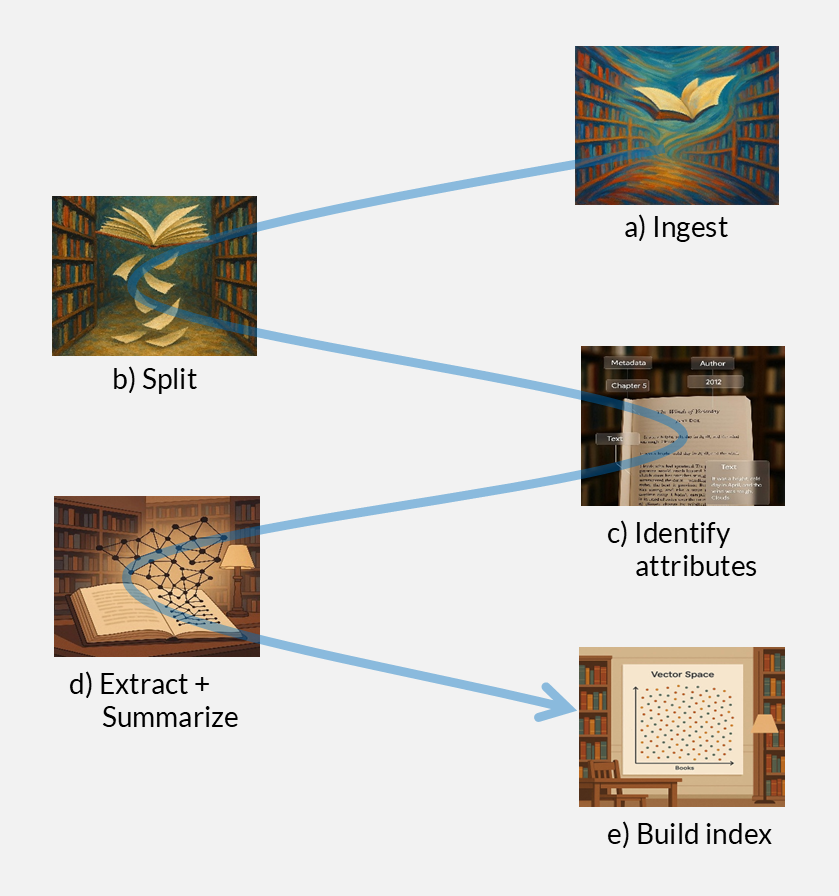
Figure 4:Document preprocessing pipeline: ingest (a), split (b), identify attributes (c), extract features (d), build index (e).
Online Phase: Query Processing
When a researcher types “neural plasticity AND memory consolidation” into the library search, the online phase begins. The system processes the query through a symmetric sequence of stages (Figure 5): (a) accept the user’s query, (b) tokenize it using the same pipeline that processed documents during indexing, (c) optionally broaden the query through spelling correction or synonym expansion, (d) compare the query’s feature vector against the vectors stored in the index to find similar documents, and (e) rank candidates by estimated relevance and return an ordered result list.
This symmetry between offline and online processing is essential: queries and documents must live in the same feature space for comparison to work.
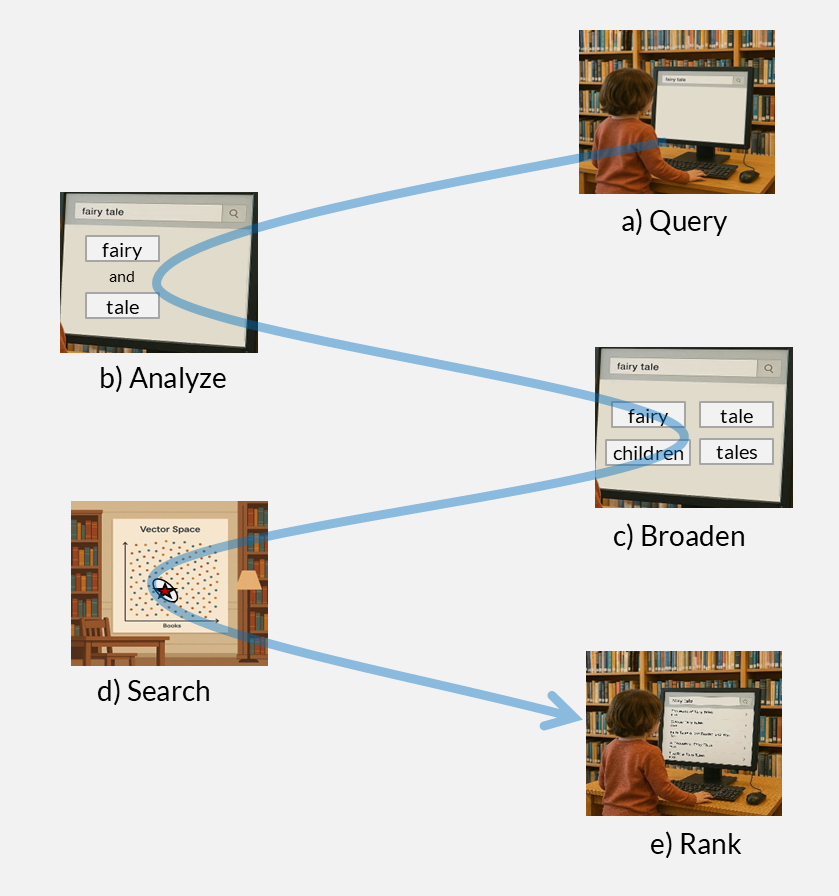
Figure 5:Online query pipeline: query (a), tokenize (b), expand (c), search (d), rank (e).
The central challenge in the online phase is relevance ranking: accurately estimating how important a document is given the query. The next sections develop the feature extraction pipeline that creates document representations, followed by the retrieval models that use those representations for scoring.